Chocolate chips or pistoles: what are we talking about?
The terminology used for baking chocolate encompasses several terms that do not all refer to the same uses.
Nugget, drop, pistole, pastille and chunk
A classic chocolate nugget measures a few millimetres and is often teardrop-shaped. The term ‘drop’ refers to exactly the same shape in English. A ‘pistole’, also known as a ‘pastille’ or ‘callet’, is a small disc of couverture chocolate intended to be melted for use in coating, chocolate fondue or moulding.
A ‘chunk’ is a large, square piece of chocolate made famous by American biscuits. La Manufacture does not offer this size, but a bar of chocolate broken up with a knife produces pieces that are very similar.
Why do these nuggets hold their shape and melt when they’re supposed to?
When mixed into cookie or cake batter, they soften slightly during baking without losing their shape: the batter acts as a barrier, ensuring the temperature rises gradually, and you’re left with clearly defined pieces with a melt-in-the-mouth centre.
When melted deliberately, they liquefy effortlessly and produce a smooth, glossy melted chocolate. This is where the difference lies compared to a chocolate chip formulated to withstand oven temperatures: with a lower cocoa butter content and higher sugar content, this type melts poorly and is unsuitable for both icing and coating.
A single product therefore covers both uses, which is rare in this price range. All that remains is to choose the right recipe for your dish.
Which chocolate chips should you choose for baking?
The extensive Secrets de Pros range includes dark, milk and ivory chocolate, as well as two flavoured varieties. The cocoa percentage, flavour profile and fat content mean that each variety is suited to a different use.
|
Référence
|
Cacao
|
Profil
|
Preferred use
|
|
Pépites de chocolat Elianza noir
|
55 %
|
Cacao grillé, réglisse
|
Brownies, fondants, flans
|
|
Pépites de chocolat Vanuari noir
|
63 %
|
Fruits rouges, poivre, miel
|
Moelleux, marbrés, coulants
|
|
Pépites de chocolat Kayambe noir
|
72 %
|
Boisé, réglisse, amertume fine
|
Polyvalent, cookies, glaçages
|
|
Pépites de chocolat Arcango noir
|
85 %
|
Épicé, puissant
|
Biscuits craquants, mousses
|
|
Pépites de chocolat Noir Infini
|
99 %
|
Cacao brut, gingembre, cannelle
|
Sorbets, ganaches peu sucrées
|
|
Pépites de chocolat Kewane
|
34 %
|
Gâteau beurré, éclats de caramel
|
Ganaches, glaçages, entremets
|
|
Pépites de chocolat Elianza lait
|
35 %
|
Crème glacée au caramel
|
Mousses, ganaches, entremets
|
|
Pépites de chocolat Vanuari lait
|
39 %
|
Équilibré, lacté
|
Madeleines, tiramisu, crèmes
|
|
Pépites de chocolat Kayambe lait
|
45 %
|
Beurre salé, miel
|
Ganaches, mousses, desserts
|
|
Pépites de chocolat Kayambe ivoire
|
36 %
|
Gâteau au beurre, lait vanillé
|
Ganaches montées, fruits acidulés
|
|
Pépites de chocolat Z Café
|
70 %
|
Grains de café arabica du Brésil
|
Tiramisu, opéra, moka
|
|
Pépites de chocolat Z Caramel
|
43 %
|
Éclats de caramel, notes lactées
|
Mousses, ganaches, desserts
|
Dark chocolate chips, ranging from 55 per cent to 99 per cent
There are five recipes in the dark chocolate chip range. The higher the cocoa content, the more liquid the dark couverture chocolate absorbs: a 72 per cent ganache requires roughly equal parts cream and chocolate, whilst an 85 per cent version requires more cream. The Kayambe 72 per cent remains the most versatile, working equally well as an ingredient or as a glaze.
Milk, ivory and flavoured chocolate chips
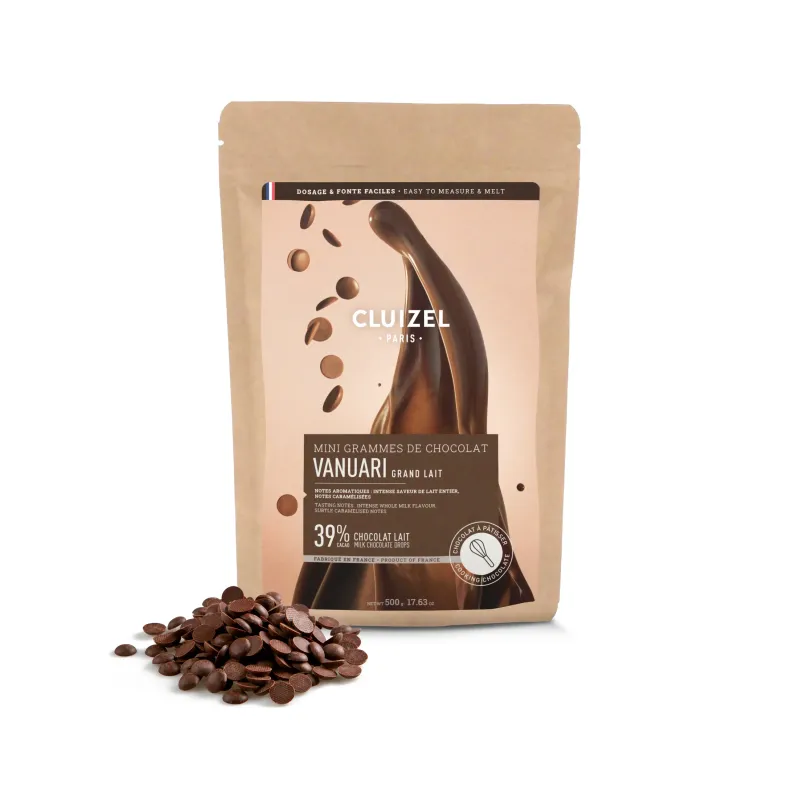
Among the milk chocolate nuggets, the Vanuari 39 per cent offers the best balance, whilst the Kayambe 45 per cent has the highest cocoa content. Milk chocolate burns more quickly than dark chocolate and should be worked at a lower temperature.
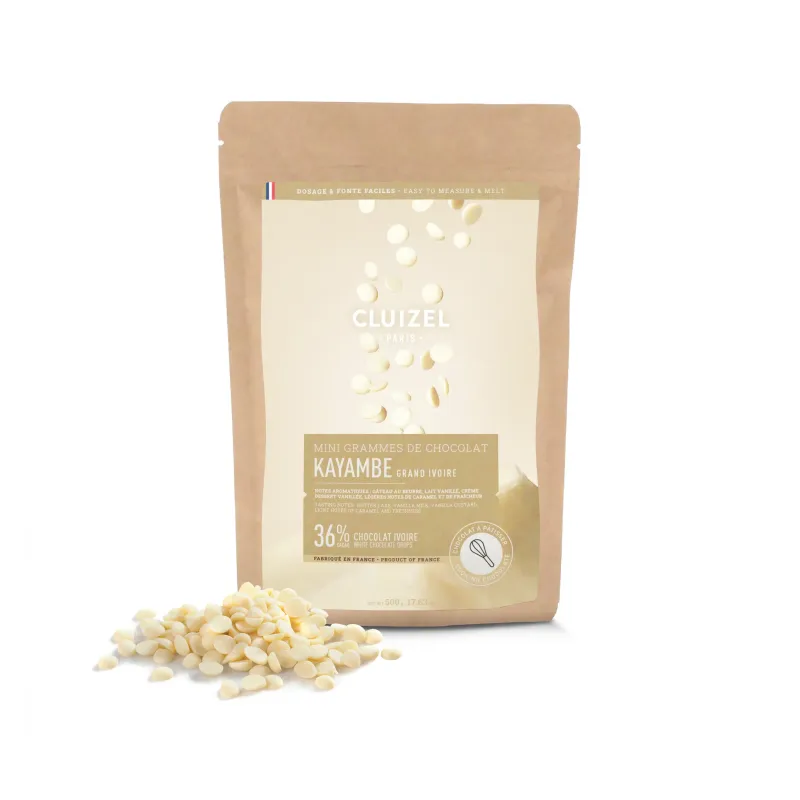
CLUIZEL uses the term ‘ivory’ where the common term is ‘white chocolate’: ivory chocolate chips are in fact white chocolate chips, containing no cocoa mass and therefore more sensitive to heat. There are two flavoured varieties: Z Café 70 per cent, with its Brazilian coffee beans, and Z Caramel 43 per cent, with its caramel chips, both of which contain solid inclusions.
How to recognise good-quality chocolate chips
Read the list of ingredients and count the lines. A high-quality chocolate bar contains between four and six ingredients: cocoa beans, sugar, cocoa butter, possibly whole milk powder, an emulsifier and vanilla.
The fat must consist exclusively of cocoa butter; it must never be coconut or palm oil
The vanilla must be natural and in pod form, not a synthetic flavouring
The emulsifier used here is rapeseed lecithin, whilst soya lecithin remains the industry standard
CLUIZEL’s commitment to quality is underpinned by the ‘Ingrédients Nobles’ label, established in 2000. It guarantees products made from 100 per cent pure cocoa butter, with no added flavourings, and free from soya and GMOs, as well as a rigorous ethical and environmental approach. It is this framework, rather than organic or fair trade certification, that guides the selection of cocoa beans and the composition of each recipe.
How do you use chocolate chips and chocolate pieces?
These chocolate nuggets can be used in three ways: mixed into a dough, melted like baking chocolate, or eaten on their own.
Included: biscuits, cakes and pastries
Fold in the chocolate chips at the end of mixing, once the flour and baking powder have been incorporated. Mixing for too long will discolour the dough and eliminate the visual contrast you’re aiming for in a cookie or a brookie. For brioches and Viennese pastries, add them during the final kneading stage.
If your chocolate chips sink to the bottom of the tin, coat them with a spoonful of the flour from the recipe: the thin film this creates will keep them in the batter. Adding a roasted hazelnut to the mixture also gives it an extra bit of texture.
How many nuggets should I use, depending on the recipe?
200 g for biscuits for five people, served with 50 g of hazelnut spread
210 g for a brownie serving ten
260 g for a chocolate tart serving ten
90 g for a panna cotta serving ten
The difference lies in the role of the chocolate in the recipe. It has the greatest impact when added in chunks, and the least when used to flavour a cream. Five chocolate chips weigh approximately 1 gram, which means there are nearly 2,500 chips in a 500 g packet.
Melting chocolate chips: bain-marie and microwave
Melting chocolate in a bain-marie remains the gold standard. Place the chocolate chips in a mixing bowl set over a saucepan of gently simmering water, ensuring the base of the bowl does not touch the water. Do not exceed 50–55 °C for dark chocolate, or 45–50 °C for milk or white chocolate.
In the microwave, heat in 30-second bursts on a medium setting. Stop when two-thirds of the nuggets have melted; the residual heat will finish the job. The convenient size of the nuggets means there’s no need to cut them up beforehand.
Glazing, coating and moulding: nuggets just like baking chocolate
This is a use that most chocolate nuggets on the market do not allow. When melted, these nuggets behave exactly like couverture chocolate discs.
To make a glaze, melt the chocolate and then thin it with hot cream or a neutral oil, adding it gradually until you achieve the desired consistency. Kayambe 72% produces the cleanest glaze, as its intense cocoa flavour reduces the sweetness of an already rich cake. Pour it over a cake at room temperature; never take it straight out of the fridge.
Whether for coating, moulding or decorative shavings, the chocolate must be tempered; otherwise, it will not set properly and will develop a white film. This process is essential for truffles, tuiles and traditional macarons. It is not necessary once the chocolate has been incorporated into another ingredient.
Ganaches, mousses and chocolate drinks
The ratio of cream to chocolate determines the success of a ganache: approximately one part cream to one part 72 per cent dark chocolate, and up to two parts chocolate to one part cream when using milk chocolate. Pour in the hot cream in three stages, stirring in small circular motions from the centre.
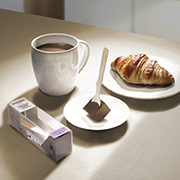
Our chocolate chips also melt straight into hot milk, and this is one of the most popular ways to enjoy them in winter and during the Christmas season. Chocolate powder doesn’t replicate the same texture or the same richness as melted couverture chocolate chips, as our hot chocolate recipe demonstrates. Allow around 50 chips per cup – about 10 grams – or use a ready-to-use hot chocolate spoon. In summer, the same base makes a chocolate slushie.
Our chocolate chip recipes
Around thirty chocolate recipes are based on these products, ranging from banana bread to Black Forest cake, with each one specifying the exact product and quantities.
How should you store your chocolate chips?
Store your chocolate nuggets at a temperature of between 16 and 18 °C, in a dry place away from light. Seal the bag by pressing out the air, or transfer them to an airtight container. Do not store them in the fridge: the moisture there dissolves the sugar on the surface, and cocoa butter absorbs odours very easily.
A white film on the surface is usually caused by a temperature difference. This ‘fatty’ blooming does not affect the taste and disappears once the chocolate has melted. ‘Sugary’ blooming, which feels rough to the touch, is caused by exposure to moisture. In both cases, use these chips for melting rather than for decoration.
Professional-quality service available to everyone
The ‘Secrets de Pros’ range brings together the chocolates that the Manufacture produces for professionals, in formats designed for home cooks.
CLUIZEL’s expertise behind every nugget
For over seventy years, Manufacture CLUIZEL has brought together the various trades of chocolate-making under one roof: Cacaofèvier®, Confectioner and Chocolatier. Roasting, grinding, conching and moulding are all carried out in-house, without using couverture chocolate purchased from a third-party producer. Since the late 1990s, the company has been working directly with farmers across the three cocoa-producing continents, and creates each recipe for chocolate chips by blending beans from several plantations.
Open to everyone
No technical expertise is required to make desserts using these chocolates. The chocolate chips format means there’s no need to break up a bar, and makes it easy to measure out the right amount straight away. The 500 g packet is ideal for regular use, whilst larger packs contain several packets for larger quantities. The ‘Secrets de Pros’ workshops allow you to take your skills to the next level, alongside our master chocolatiers.
Commitment to quality
CLUIZEL’s commitment to quality is based on meticulous control at every stage of production, from the selection of the cocoa beans right through to the finished product. Nutritional information and allergens are listed in detail on each product information sheet. None of the twelve recipes contain gluten amongst their ingredients, but all carry a warning about possible traces of gluten, nuts and, in most cases, milk.
Frequently asked questions about chocolate chips
What is the difference between a chocolate nugget and a chocolate pistole?A ‘pistole’ is a covering disc intended to be melted, whilst a ‘pépite’ is a small piece intended to be mixed in. These products are suitable for both uses, as they hold their shape in the dough and melt just as well as a ‘pistole’.
Can you use chocolate chips or chunks for icing?
Yes, provided it is genuine couverture chocolate. A chocolate chip with a low cocoa butter content produces a thick, dull glaze, whereas these recipes melt into a smooth, glossy chocolate.
Can you replace a bar of chocolate with chocolate chips in a recipe?
Yes, for the same weight and the same percentage of cocoa. A 70 g bar can be replaced by 70 g of chocolate chips without any adjustment. The chips even provide a more precise measurement: whereas a bar breaks into uneven squares, five chips weigh 1 gram, allowing for the most accurate measurement.
The packet is another advantage. It reseals after each use, whereas a partially eaten bar remains exposed to air and odours, which shortens its shelf life.
How can you measure the quantity of nuggets without a set of scales?
Count them. Five nuggets weigh about 1 gramme, which works out at 500 nuggets per 100 g and around 50 for a cup of hot chocolate.
For larger quantities, work in fractions of a 500 g packet. Cookies for five people use 40 per cent, a ten-portion brownie uses just over 40 per cent, a ten-portion chocolate tart uses just over half, and a panna cotta for ten uses less than a fifth.
What should you do if the chocolate chips have melted in the bag?
Nothing is lost. Leave the bag to return to room temperature, between 16 and 18 °C, rather than in the fridge, where the moisture would cause the chocolate to turn white. The block will solidify again within a few hours and can then be broken up with a knife.
The resulting pieces are no longer the standard size and are no longer suitable for regular use as inclusions. They remain ideal for all melted chocolate preparations – such as ganache, icing, mousse or hot chocolate – where the shape is of no importance.
Can you eat chocolate chips on their own?
Yes. These are couverture chocolates, unlike technical chocolate chips, which have a lower cocoa butter content and leave a dry sensation in the mouth. They can be enjoyed on their own or sprinkled over a dessert.
Should you temper chocolate chips?
Only when the chocolate remains visible after cooling: coating, moulding, shavings, decoration. Ganache, mousse or cake batter do not require tempering.