Milk chocolate chips or pistoles: what are we talking about?
Nuggets, pistoles, pastilles: three words for formats that are not used in the same way.
Nugget, pistole, pastille: two uses, one product
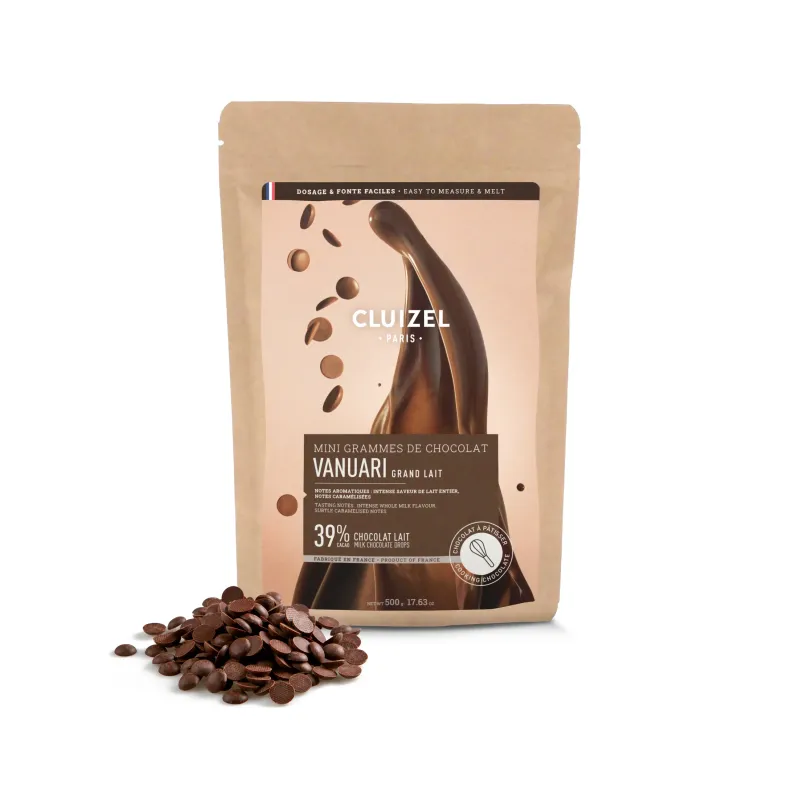
A few millimetres in size, often teardrop-shaped: this is the nugget. The larger disc that professionals melt down for a glaze or moulding is called a ‘pistole’, ‘pastille’ or ‘callet’. As for the ‘chunk’, which isn’t part of the range, a bar of milk chocolate cut with a knife produces the equivalent in irregular pieces.
When used in cookie or cake batter, these four shapes retain their design and texture. Roll them first in a tablespoon of flour taken from the recipe: the thin layer of flour prevents them from sinking to the bottom of the tin and stops them from spreading.
When melted in a bain-marie, however, they become a perfectly smooth and glossy chocolate. A chocolate chip designed to withstand baking cannot do both: its formula, which is low in cocoa butter and high in sugar, results in a thick mass that is unsuitable for use as either a glaze or a coating.
All that remains is to choose the right recipe for your dish.
Which milk chocolate chips should you choose for baking?
The range comprises four recipes, from the mildest to the most cocoa-rich.
|
Référence
|
Cacao
|
Profil
|
Preferred use
|
Prix (500 g)
|
|
Pépites de chocolat Elianza lait
|
35 %
|
Caramel ice cream
|
Mousses, desserts, sweet fillings
|
21,00 €
|
|
Pépites de chocolat Vanuari lait
|
39 %
|
Well-balanced, milky
|
Ganaches, tarts, banana bread
|
24,50 €
|
|
Pépites de chocolat Z Caramel
|
43 %
|
Caramel chips, milky notes
|
Mousses, ganaches, desserts
|
26,00 €
|
|
Pépites de chocolat Kayambe lait
|
45 %
|
Salted butter, honey, cocoa-flavoured
|
Ganaches, icings, desserts
|
26,00 €
|
Which cocoa percentage should you choose, between 34 per cent and 45 per cent?
In a 34 per cent chocolate, two-thirds of the recipe consists of sugar and milk powder. In a 45 per cent chocolate, it’s just over half. The sweeter your recipe already is, the higher the percentage should be: a biscuit works well with Elianza 35 per cent, whilst a ganache benefits from Kayambe 45 per cent.
The Vanuari 39% takes centre stage. It’s the one to go for if you’re only keeping one, as it works just as well as an ingredient as it does in a hot chocolate. The Kewane 34% nuggets, listed in another category, round off the range with the mildest, most biscuit-like flavour.
How to choose the right milk chocolate chips for your recipes
The key lies in the list of ingredients. A good-quality chocolate chip contains five or six: cocoa mass, sugar, cocoa butter, whole milk powder, an emulsifier and vanilla.
The fat content must consist exclusively of pure cocoa butter; it must never contain coconut or palm oil
The vanilla must be natural and in pod form, rather than a synthetic vanilla flavouring or extract
The emulsifier used here is rapeseed lecithin, whilst soya lecithin remains the industry standard
These four products are made in France by Manufacture CLUIZEL, using cocoa beans selected from partner plantations across the three cocoa-producing continents.
How do you use milk chocolate chips?
There are three ways to use them: mixing them into a batter, melting them as baking chocolate, and eating them straight from the packet.
As an ingredient: biscuits, cakes, muffins and pastries
Fold the chocolate chips in at the end of mixing, once the flour and baking powder have been incorporated. Mixing for too long will colour the dough and diminish the visual contrast. For brioches, milk buns and pastries, add them during the final kneading stage.
As milk chocolate is sweeter than dark chocolate, reduce the amount of sugar in your mixture slightly if you’re used to baking with 70 per cent dark chocolate.
How many chocolate chips should you use, depending on the recipe?
|
Recette
|
Référence
|
Quantity
|
Portions
|
Preparation and cooking
|
|
Banana bread
|
Vanuari lait 39 %
|
150 g
|
8 people
|
10 min et 45 min
|
|
Tarte au chocolat au lait
|
Vanuari lait 39 %
|
260 g de ganache
|
8 people
|
10 min et 20 min
|
The difference lies in the role of the chocolate. It has the greatest impact when used in the ganache, and the least when added in chunks. Five chocolate chips weigh approximately 1 gram, which means there are nearly 2,500 chips in a 500 g packet. Cookie dough also benefits from having 50 g of hazelnut spread added to it.
Melting chocolate chips: bain-marie and microwave
The bain-marie remains the safest method: place a mixing bowl over gently simmering water, ensuring it does not touch the water. Milk chocolate cannot withstand temperatures above 45–50 °C, whilst dark chocolate can withstand 50–55 °C.
The microwave also works, in 30-second bursts at medium power. Stop when two-thirds have melted and let the residual heat finish the job.
Glazing, coating and moulding: chocolate chips just like baking chocolate
Few chocolate chips on the market pass this test. Once melted, they can be worked just like any other chocolate coating.
To make a glaze, melt the chocolate chips, then temper the chocolate with hot cream or a neutral oil, adding it little by little until the desired texture is achieved. Kayambe 45 per cent, the chocolate with the highest cocoa content in the milk range, produces the least sweet-tasting glaze on an already rich cake. Work on a cake that has been left to return to room temperature.
As soon as the chocolate remains visible after cooling, coating, moulding or being cut into shavings, tempering becomes essential: without it, crystallisation fails and a whitish film appears. When incorporated into a ganache or a mixture, however, it is not necessary.
Ganaches, mousses and melt-in-the-mouth desserts
Milk chocolate contains less cocoa butter than dark chocolate, so you need more of it to achieve the same consistency. Whilst a ganache made with 72 per cent dark chocolate requires roughly one part cream to one part chocolate, a milk chocolate ganache can require as much as two parts chocolate to one part cream.
Pour in the hot cream in three stages, stirring in small circular motions from the centre until you have a smooth, glossy centre.
Hot chocolate, drinks and afternoon tea
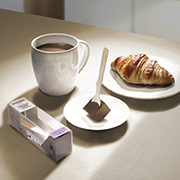
When added to hot milk, these chocolate chips melt on their own: this is one of their most popular uses in winter and at Christmas. Allow about fifty chocolate chips per cup – around ten grams – whereas cocoa powder will not give the same creaminess or lingering flavour. The hot chocolate spoon applies the same principle in a ready-to-dip form, and these nuggets can also be eaten on their own.
What to pair milk chocolate with
|
Accord
|
Référence conseillée
|
Idée de préparation
|
|
Caramel
|
Z Caramel 43 %, Elianza 35 %
|
Mousses, entremets
|
|
Noisette et amande
|
Vanuari 39 %
|
Cookies, pâte à tartiner
|
|
Fleur de sel
|
Kayambe 45 %
|
Sablés, glaçages
|
|
Banane
|
Vanuari 39 %
|
Banana bread
|
|
Café
|
Vanuari 39 %
|
Tiramisu
|
Citrus fruits should be avoided, as their acidity overpowers the milk. Our milk chocolate recipes provide further examples, from rice pudding to raspberry marshmallows.
How should you store milk chocolate chips?
Milk chocolate is the most sensitive of the three types when it comes to storage.
The ideal temperature range is between 16 and 18 °C, in a dry place away from light. Squeeze out any air before resealing the packet, or transfer the chocolate chips to an airtight container. Avoid the fridge: condensation when the chocolate is taken out of the cold damages its surface.
The fats in milk oxidise more quickly than cocoa butter alone, resulting in a shorter best-before date than that of dark chocolate. After this date, the product remains edible, but it loses some of its aromatic freshness.
Price, format and commitment to quality
The four varieties are priced between €21.00 and €26.00 per 500 g packet, which works out at between €42 and €52 per kilo. Plantation milk chocolate couverture is usually sold to trade customers in bags weighing several kilos: this format makes a chocolate – previously reserved for professional workshops due to its large quantities – accessible to the general public. Delivery is free in mainland France and across Europe on orders of €85 or more, and the chocolate chips are available in specialist shops as well as at our partner outlets.
In a milk chocolate range, quality is first and foremost determined by the ratio of cocoa to sugar and milk powder. Achieving this balance requires in-house control over roasting, grinding and conching, without using couverture chocolate sourced from a third party. The Secrets de Pros workshops extend this approach to the kitchen.
Frequently asked questions about milk chocolate chips
Are milk chocolate chips suitable for people with lactose intolerance?
No. Whole milk powder is listed as an allergen in all four recipes, along with possible traces of gluten and nuts. For dairy-free baking, opt for dark chocolate chips, which do not contain any dairy.
Why has my milk chocolate become grainy as it melted?
There are two possible causes. Just a few drops of water falling into the mixture are enough to cause the sugar particles to clump together. Overheating has the same effect by burning the milk proteins, which is why it is important not to exceed 50 °C.
Milk chocolate or white chocolate: which should you choose for your recipe?
White chocolate contains no cocoa mass: it is sweeter and more sensitive to heat. Milk chocolate works best with caramel, hazelnuts and banana, whilst white chocolate chips are at their best with raspberries, apricots or strawberries.
Can you replace dark chocolate with milk chocolate in a recipe?
Yes, by adjusting two factors. Reduce the sugar by about 20 g for every 100 g of chocolate replaced, otherwise the dessert will be sickly sweet. Then increase the amount of chocolate by about a third in ganaches and crèmes.
Are there any organic, fair-trade or loose milk chocolate chips available ?
These nuggets are blended chocolates: each recipe is created from a blend of cocoa beans from various origins, formulated to ensure a consistent flavour profile from one packet to the next. The focus is therefore on the raw material itself, through the ‘Ingrédients Nobles’ label created in 2000 by the Manufacture, which guarantees 100 per cent pure cocoa butter, with no added flavourings, no soya and no GMOs, as well as an ethical and environmentally responsible approach. However, the range is neither certified organic nor fair trade, nor is it sold in bulk: it is available in 500 g resealable sachets.
Can you replace a bar of chocolate with chocolate chips?
Yes, provided they weigh the same and have the same percentage of cocoa. Chocolate chips actually provide a more precise measurement: whereas a bar breaks into uneven pieces, five chocolate chips weigh 1 gram. The packet reseals after each use, whereas a partially eaten bar remains exposed to the air and odours.
How do you measure out the right amount of chocolate chips without a set of scales?
Count them. Five nuggets weigh 1 gramme, which means 500 nuggets make up 100 g, and around fifty are enough for a cup of hot chocolate. For larger quantities, think in terms of fractions of a packet: a banana bread for eight people uses less than a third of a packet, whilst the ganache for a tart for eight uses just over half a packet.
What should you do if the milk chocolate chips have melted in the bag?
Leave it to return to room temperature, between 16 and 18 °C, rather than in the fridge, where the moisture would cause the chocolate to turn white. The block will solidify again within a few hours and can be broken up with a knife. As the pieces will have lost their shape, use them in melted preparations rather than as an ingredient.